Allergy tests
Allergy tests help identify which substances the body is sensitive to. A skin test gives an answer within about a quarter of an hour and takes half an hour to 45 minutes in all, and a blood test suits when medicines cannot be stopped. The result matters only when it fits the patient’s symptoms.
First a conversation, then a test
The diagnosis starts with a conversation and a physical examination, and the tests come to confirm what the history suggests. So there is no point testing “everything”, and tests done for no reason may only confuse.
Four tests at a glance
Each test answers a different question. The doctor chooses according to the symptoms, the medicines you take and the suspected cause.
| The test | What is tested | How it is done | When it suits |
|---|---|---|---|
| Skin test | The local reaction of the skin to allergen extracts | A shallow prick on the arm, read after about a quarter of an hour | When antihistamines can be stopped before the test |
| Blood test | Specific IgE antibodies to allergens the doctor chooses | A blood sample, the results come within a few days | When medicines cannot be stopped, when there is a skin disease such as eczema, or when exposure to the allergen may be dangerous |
| Patch test | Contact allergy, that is, allergic contact dermatitis | Patches on the back for 48 hours, and a second look at the skin 48 hours later | When contact allergy is suspected |
| Challenge | The reaction to a food or a medicine | Increasing amounts under medical supervision | When the other tests are not enough and the picture is unclear |
The skin test (Skin Prick Test)
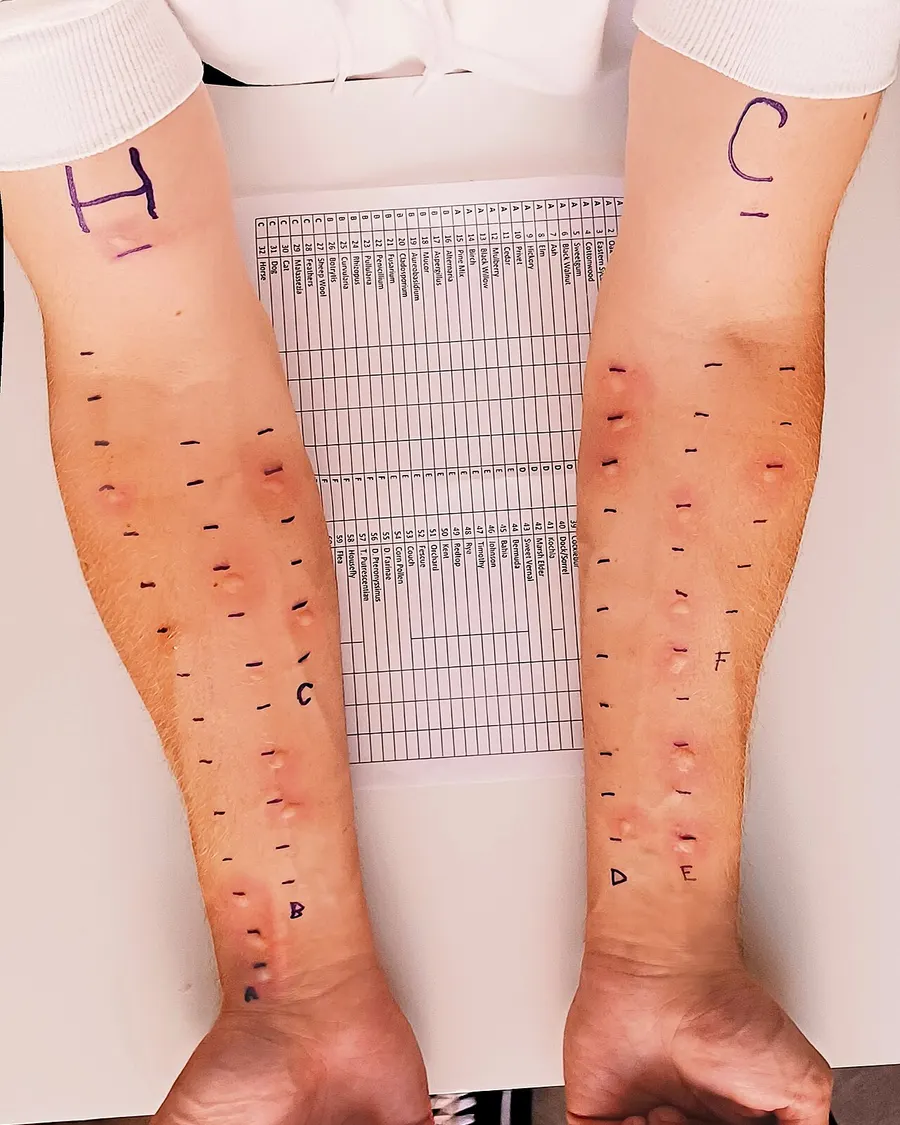
Small drops of allergen extracts are placed on the skin, usually on the arm, and the top layer of the skin is pricked gently. Throughout the test the results are compared with positive and negative controls, which also help identify the effect of medicines on the result. The local reaction is read after about a quarter of an hour, and the results are known immediately at the end of the test. The whole visit takes between half an hour and 45 minutes.
There is no need to fast. Rarely, irritation, redness or mild swelling appear at the prick site, and they usually pass within a few hours. The risk of a systemic allergic reaction is very low, under 1%, so a skin test should be done in a place that has resuscitation equipment.
Allergists usually prefer a skin test: the result is immediate, it is cheaper, and it is sensitive to subtle allergies.
How to prepare: medicines to stop
Antihistamines weaken the skin’s reaction and may hide an allergy, so they are stopped before a skin test. The exact details depend on the medicine and on the doctor’s instructions, but the rule of thumb is this:
- Most antihistamines: different guidelines range from 3-4 days to 7 days. In practice it is usual to stop 3 to 7 days before the test, as the doctor instructs.
- Hydroxyzine (Atarax): 10 days before the test.
- Some psychiatric medicines, such as amitriptyline and doxepin, may weaken the test result. Do not stop them without consulting your treating doctor.
- Beta blockers: it is recommended to stop them 5 to 7 days before the test, as the doctor advises. They do not affect the result, but can slow the response to adrenaline if a severe reaction occurs, which is an extremely rare event.
- Do not stop a regular medicine, such as an inhaler, a heart medicine or a psychiatric medicine, without a doctor’s instructions.
For a blood test there is no need to stop medicines.
The blood test (specific IgE antibodies)
The test measures in the blood the level of IgE antibodies, which are linked to allergic reactions, to allergens the doctor chooses. The results come within a few days. A blood test suits when medicines cannot be stopped, when there is a skin disease such as eczema, or when a small exposure to the allergen may be dangerous. There is no need to fast.
The patch test
A test for contact allergy, that is, for allergic contact dermatitis. Patches with substances that may cause allergy are stuck on the back and left for 48 hours, and the skin is examined again 48 hours later, because the reaction usually develops within 48 to 96 hours. It is recommended not to wet the back during the test and to avoid excessive effort. Before the test, avoid a strong steroid cream on the test area for three days, and tell the doctor about medicines that suppress the immune system. Antihistamines do not interfere with this test.
The challenge: when the tests are not enough
In a food or drug allergy, when the picture is unclear, a challenge is carried out: increasing amounts of the food or the medicine are given under medical supervision, and we watch for a reaction. In a food allergy this is the most accurate test. In a penicillin allergy, after a negative skin test, we usually continue to a challenge by mouth.
How to read the result
- A positive result matters only if it fits the personal story. You can be sensitive to a substance on a test without having symptoms.
- A negative result does not rule out allergy. The test includes only common allergens, and some people have a runny nose that is not allergic.
- IgG tests for food are not recommended for diagnosing allergy. They detect exposure, and usually tolerance, not allergy.
Frequently asked questions
Does a skin test hurt?
The prick is shallow and brief. Afterwards irritation, redness or mild swelling may appear at the spot, and they usually pass within hours. If you are anxious, it is worth saying so beforehand.
How long does the test take, and when do I know the result?
The visit takes about half an hour to 45 minutes. The reaction is read after about a quarter of an hour and the result is known at the end of the test. For a blood test the results come within a few days.
Do I need to come fasting?
No, neither for a skin test nor for a blood test.
Do I need to stop allergy medicines?
For a skin test yes, usually 3 to 7 days before the test, as the doctor instructs. For a blood test no. Do not stop other regular medicines without instructions.
What is the difference between a skin test and a blood test?
A skin test gives an answer immediately, and is more sensitive. A blood test suits when medicines cannot be stopped, when there is a severe skin disease, or when there is a risk in exposure to the allergen.
Does a positive result mean I am allergic?
Not necessarily. It matters only if it fits the symptoms and the history.
Is it worth having an IgG test for food?
No. The test is not recommended for diagnosing allergy, and it tends to reflect exposure to the food.
Sources
Would you like to talk about this?
If you have these symptoms or are unsure about the next steps, it is best to consult your treating doctor. To arrange an appointment, you can contact us.
Book an appointmentThe information in this article is for information only and is not medical advice, a medical diagnosis or a recommendation for treatment. In any medical problem, consult a licensed physician.
When to be tested
- You suspect an allergy and the symptoms keep coming back or affect daily life.
- There was a reaction after a food, a medicine or a sting.
- You were told that you are allergic, and there is no test that confirms it.